
Self-Drive Car Rental in Egypt: Checks Before Your First Journey
Collecting a rental car is the moment to turn a booking conversation into a clear understanding of the vehicle you will actually drive. Before your first journey, compare the car with the agreed details, review its visible condition, record the starting information and become familiar with the controls while parked. A calm collection process gives you space to ask questions before traffic, passengers and directions compete for your attention.
This guide to self-drive car rental in Egypt focuses on that collection stage. It is a practical sequence for the customer, rather than a mechanical inspection or a statement of contract terms. Vehicle availability, rental duration, eligibility, documents, permitted use and return arrangements must be confirmed for your particular booking with Limousine Cairo. If you are still choosing the service type, begin with our guide to renting a car with a driver or for self-drive, then use this checklist when the collection is arranged.
If your stay includes private parking, read our guide to choosing a rental car for garage access and usable parking space and gather the property information before confirming the vehicle.
Before collecting a self-drive rental car in Egypt
A useful collection starts before the vehicle arrives. Keep the latest booking confirmation available and check who will meet you, where the meeting will take place and how to contact the person responsible. Ask beforehand which documents and arrangements apply to your booking. Do not rely on a list from another rental company or an old conversation about a different vehicle: requirements may depend on the specific request.
Self-drive car rental: match the vehicle with your confirmation
Compare what has been confirmed with the car presented for collection: category, model where expressly agreed, service type and any equipment essential to your plans. Colour or model year should be treated as confirmed only when they form part of the actual agreement. A photograph or a model listed in the catalogue is a starting point for discussion; it does not establish that a particular vehicle is available for self-drive on your dates.
If something differs, describe the difference before accepting the arrangement. Explain the practical consequence: perhaps your luggage needs a separate boot, or the offered vehicle has a driving position you have not used before. Ask the booking team to clarify the option and update the relevant details. Do not assume that a replacement, upgrade or other solution follows automatically from a difference.
Agree the meeting point and allow time for the review
Use an exact meeting point rather than a neighbourhood name alone. A building may have several entrances, and the nearest entrance may not provide suitable space to review a parked car. Confirm the location through the agreed contact channel and ask where the handover can take place without obstructing traffic. Collection at a particular address remains something to agree, rather than a service promised by this guide. If the meeting place or time changes, send the revised details to the booking team and wait for confirmation; sending a message alone does not establish that the change has been accepted.
Keep the review separate from your departure deadline. If a family member is waiting or a meeting is approaching, tell the booking team in advance so the arrangements can be discussed realistically. There is no fixed number of minutes that suits every collection. What matters is having enough opportunity to read the relevant information, ask questions and understand the car before beginning the journey.
Rental car collection: record the visible condition
Walk around the parked vehicle in a suitable, safe place and review the areas you can see normally. Clear photographs can support a shared record of its condition at handover, particularly when a mark is difficult to describe. Use general views for context and closer views for an observation, while avoiding other people and their personal information. Ask how observations should be entered in the collection record and retain the agreed response.
Look at the bodywork, glass and doors
Notice visible marks on the bodywork, bumpers and mirrors, and look at the glass from the normal viewing position. Check that you understand the operation of the doors and luggage compartment, without forcing a handle or unfamiliar mechanism. If you see a mark, identify its position clearly instead of describing the whole side of the car as damaged. A contextual photograph and a specific description are easier to discuss together.
Review the cabin too: seats, accessible storage areas and any item included in the handover. Personal comfort matters, so raise an issue such as a strong smell or an interior condition that concerns you before departure. Recording a concern does not itself settle responsibility, amend the contract or prove that the vehicle is ready to drive. It creates information for the appropriate person to review.
Observe wheels and tyres without treating this as a technical inspection
From a safe standing position, notice obvious concerns around the visible tyres and wheels, such as an apparent cut or an unusually low-looking tyre. Do not crawl beneath the vehicle, remove components or try to diagnose a mechanical issue. A customer walkaround cannot establish tyre pressures, roadworthiness or the condition of hidden components. Those are matters for appropriate checks by qualified people.
If an observation raises a safety concern, pause the collection and seek qualified assistance through the agreed contact. Do not drive merely because the issue has been photographed or because a short journey seems convenient. Equally, do not interpret a clean exterior or a recent model year as evidence that every technical check has been completed.

Before your first journey in a rental car: learn the controls while parked
Even a familiar vehicle category may have controls arranged differently from your own car. Ask the handover contact to explain anything unclear while the car remains safely stationary. Reading the relevant vehicle guidance can help, but do not guess from a similar model or attempt to learn a feature while moving. The aim is to remove avoidable uncertainty before you enter traffic.
Set the seat, mirrors and seat belt before moving
Adjust your driving position so you can use the pedals and controls comfortably, then set the mirrors for that position. Locate the seat adjustment mechanisms before operating them and ask for help if their function is unclear. Check that your seat belt can be fastened normally, and make sure the passengers understand their own seating and belts before departure. Avoid carrying out these adjustments while driving.
Check your normal view around the vehicle and notice areas that remain difficult to see. Moving from your own car to a rental can change your judgement of the bonnet, rear corners or distance from the kerb. If you cannot find a workable driving position or a belt seems abnormal, raise the issue before proceeding. An instruction from a website cannot confirm that a particular car fits a particular driver.
Locate lights, wipers, climate controls and demisting functions
Find the controls you may need quickly: lights, indicators, wipers, hazard lights and the functions used to clear the windows. Ask how the climate system is operated on this vehicle and where the relevant controls are located. Screens and buttons can vary between trims, even when the model name looks familiar. Do not assume that an automatic setting will always do what you expect.
Understand the basic operation of the parking brake and transmission before moving, using the explanation and guidance appropriate to the actual car. If a dashboard message remains unclear, ask for it to be explained rather than dismissing it. Do not experiment with unfamiliar systems in traffic, and do not treat this article as instructions for a particular transmission or warning light.
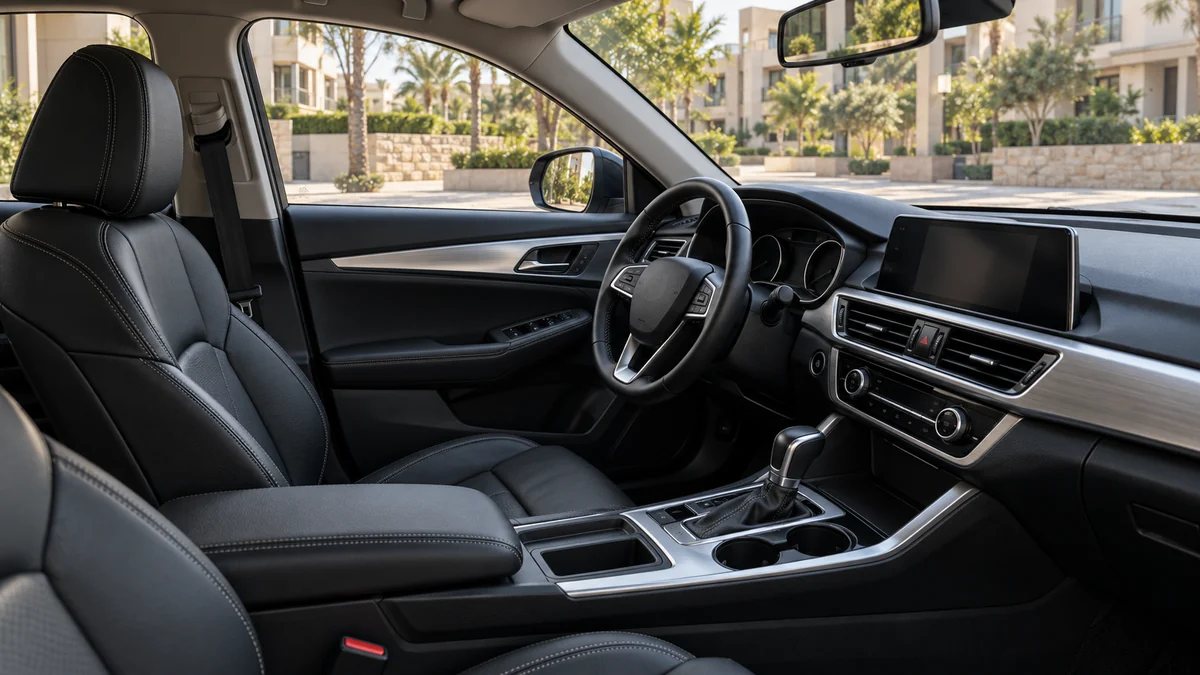
Sedan car rental: review visibility and luggage access
A sedan may suit your preference for a separate luggage compartment, but suitability depends on the specific vehicle and what you need to carry. During collection, compare your real luggage with the available space and keep the intended passengers in mind. A photograph taken with an empty boot does not establish whether your bags will fit with the car’s actual seating arrangement.
Sedan car rental: check visibility and the boot opening
From the adjusted driving position, notice the rearward view and the parts of the vehicle that are less visible. Then look at the boot opening, its height and how the luggage can be placed without forcing the lid. Keep bags from obstructing the driver’s view or access to essential controls. Ask how the key should be handled when opening the boot, and avoid leaving it inside unintentionally. If the arrangement does not work, discuss the requirement before setting off rather than assuming that changing the seating is acceptable.
For a broader assessment of space, our passenger and luggage planning guide explains how to describe the bags and seating you need. At collection, the question becomes concrete: does the offered car suit the plan that was agreed? This section does not promise a particular boot capacity, model or seating layout.

SUV rental in Egypt: understand the vehicle’s dimensions
An SUV can feel different from a sedan when you sit at the wheel, approach a parking space or open the luggage compartment. That difference deserves attention before the first journey. Review the actual driving position and access rather than choosing solely by the category name. The label SUV does not by itself establish suitability for a particular route, surface or use.
SUV rental: confirm the actual equipment before departure
Ask which assistance features are fitted to the offered car and have any unfamiliar operation explained while parked. A camera or parking sensor shown in a promotional image may not be fitted to every trim. Even where present, assistance equipment does not replace direct observation or the driver’s judgement. If equipment is important to your choice, confirm it before booking and review it again at collection.
Consider the space needed to open the doors and tailgate at your intended stops. A car that looks manageable in an open collection area may require more thought in a narrow parking space. Discuss the intended use with the booking team and do not infer off-road permission or capability from ride height. You can explore categories in the Limousine Cairo car catalogue, with the actual model and availability confirmed for your request.

Fuel, odometer and keys: agree the starting record
Review the displayed fuel level and odometer reading with the person handling collection, and ask how those details are recorded. Where photographs are appropriate, include enough context to make the reading understandable. A displayed estimate of remaining driving range is not the same thing as a fixed quantity of fuel, so ask if the record is unclear rather than making your own assumption.
Confirm the fuel type for the actual vehicle and the agreed return requirements. Ask where the relevant information can be found, and retain the booking team’s explanation. This guide does not prescribe a fuel policy or a distance allowance. Likewise, check which keys and accompanying items are being handed over and how they are listed, without assuming that a second key or particular accessory is included.
Clarify the return date, time, place and contact procedure before departure. If you might need an extension or a different return location, raise that possibility early; it needs agreement and must not be treated as automatic. Keep the relevant contact accessible separately from your navigation so you can find it when needed. If you pair a phone with the car, ask how to remove your pairing information before return, following the instructions for the actual system. Set up navigation and any connection while safely parked rather than handling these tasks after moving.
If something is unclear before departure, pause and ask
Use a specific description: what you observed, where it is and what clarification you need. A useful message might identify a mark on a door, a difference from the booking confirmation or an unfamiliar dashboard message. Ask who can review it and how the outcome will be recorded. Keep the response with your booking information rather than relying only on an informal remark.
Separate an unanswered convenience question from a possible safety issue. For the latter, do not drive; request appropriate assistance and clarification before proceeding. Do not try to solve an unfamiliar technical fault yourself or accept a photograph as proof that a concern has been resolved. Any change to the vehicle or arrangement should be reviewed explicitly with the responsible booking contact.
A hypothetical example: an organised car collection
Imagine a traveller collecting a sedan for a stay in Cairo. This is an illustrative scenario, not a customer story or a description of a confirmed booking. Before the meeting, the traveller keeps the latest vehicle details and contact available. At collection, they compare those details, look around the car and notice a small visible mark near a door. They ask for its position to be recorded and retain the response.
Next, while parked, the traveller adjusts the seat and mirrors and asks how to operate an unfamiliar wiper control. Their bags fit in the luggage compartment without changing the agreed passenger arrangement. They review the starting fuel and odometer record, then confirm the return contact and location. If instead a possible safety concern had appeared, the sequence would stop pending appropriate assistance; completing the checklist would not override that concern.
A collection checklist and a message for the booking team
Keep this short list beside your confirmation. It supports the handover conversation and does not replace the contract, vehicle instructions or a qualified assessment:
- Match the offered vehicle and essential equipment with the confirmed arrangement.
- Review visible condition and ask for observations to be recorded.
- Set the driving position, mirrors and belts while stationary.
- Understand the essential controls and raise unclear messages.
- Review luggage access, starting readings, keys and accompanying items.
- Confirm the return arrangements and the appropriate contact for questions.
For a new request, you can send: “I would like to rent a car in Egypt for self-drive. My dates are [dates], the expected use is [use], and I need space for [passengers and luggage]. Please confirm available options, booking requirements, collection arrangements and the details I should review before departure.” These brackets are prompts to complete, rather than a confirmed booking or a promise of availability.
Review the relevant car rental services and contact Limousine Cairo by WhatsApp or phone: 01118974446, 01118974448 or 01118964445. The website is a catalogue; vehicle selection and booking details are confirmed directly.
If you are booking because your own car is going into the workshop, see our guide to planning a rental while your own car is being repaired to coordinate the rental period, possible extensions and the return handover.
Summary: begin with a clear handover
For self-drive car rental in Egypt, collection is your opportunity to understand the actual car and resolve questions before the journey. Compare the confirmation, record visible observations, learn the essential controls while stationary and review the starting information and return plan. Keep the process practical and specific. If a safety concern remains, do not drive until you have obtained appropriate assistance and the concern has been addressed.
As your booking approaches its end, use the self-drive car return and handover guide to plan the appointment and compare the vehicle with your collection record.
Frequently asked questions
Does a car catalogue photograph confirm the vehicle I will collect?
No. Confirm the actual vehicle, dates, service type and essential equipment with the booking team. Review the offered car against that confirmation at collection, and discuss any difference before departure.
Should I photograph the rental car when collecting it?
Clear general and detail photographs can support a visible-condition record. Ask how observations should be documented and retain the relevant response. Photographs do not replace the agreed record or establish the car’s technical condition.
Can I learn unfamiliar controls during the first journey?
Review essential controls while the car is safely stationary. Ask for an explanation before moving if anything is unclear, including the transmission, parking brake, lights, wipers or a dashboard message.
What should I do if a dashboard warning is unclear?
Do not assume it is normal or drive to see whether it disappears. Ask the responsible contact for an explanation and appropriate qualified assistance before moving. If you have a safety concern, do not begin driving until it has been addressed.
Are fuel and return arrangements the same for every booking?
Do not assume they are. Ask for the details applying to your booking and review them at collection. Record the odometer reading, displayed fuel level and keys in the agreed way, rather than carrying over the terms of an earlier rental.